

God never shows up empty-handed. But on this particular evening in Eden, He came carrying questions that would reshape everything we thought we knew about divine justice, human failure, and the most unlikely rescue plan in history.
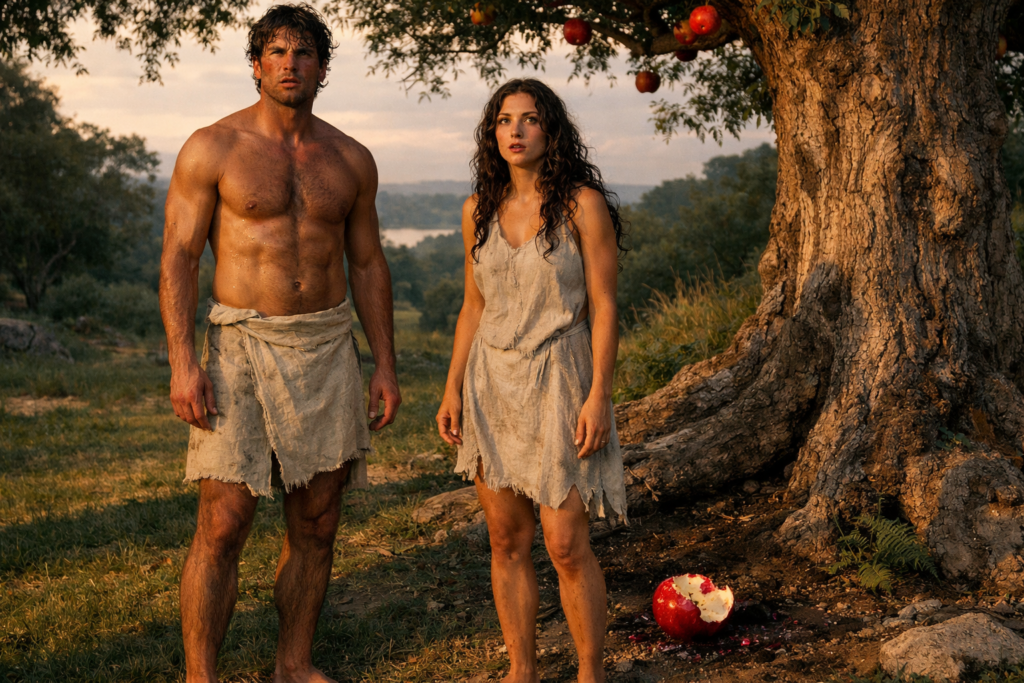
Picture this: Adam and Eve, fresh off their catastrophic decision to eat from the forbidden tree, are now playing the world’s first game of hide-and-seek with their Creator. They’re crouched behind fig leaves and trembling behind trees, convinced they’ve outsmarted omniscience itself.
But here’s what catches me every time I read Genesis 3:8-24. God doesn’t come stomping through Eden like an angry parent ready to ground His kids for eternity. He comes walking. The Hebrew word suggests a gentle stroll, the kind of leisurely pace that says, “I have all the time in the world for this conversation.”
Think about that for a moment. The God of the universe, who could have appeared in thunder and lightning, chooses instead to take an evening walk. This isn’t a manhunt. It’s a search and rescue mission disguised as a casual stroll.

When Perfect Love Meets Perfect Failure
“Where are you?” (Genesis 3:9). Three words that echo through every human heart that’s ever felt lost.
Now, obviously God knew exactly where Adam was hiding. This wasn’t a divine GPS failure. But Adam needed to confess where he actually was spiritually, emotionally, relationally. The question wasn’t about geography. It was about accountability.
And Adam’s response breaks my heart every time: “I heard your voice in the garden, and I was afraid because I was naked; so I hid” (Genesis 3:10).
These were the first words a human being ever spoke directly to God after sin entered the picture. Not “I’m sorry.” Not “I was wrong.” But “I was afraid.” The relationship that had been characterized by perfect intimacy was now defined by fear and shame.
But here’s where the story takes an unexpected turn. Instead of immediate judgment, we get the world’s first courtroom drama. God begins what theologians call the “divine tribunal,” but it doesn’t unfold the way you’d expect.

He questions Adam first, not because Adam sinned first, but because Adam carried the responsibility. The command had been given to him. Then He questions Eve. But notice this: He doesn’t question the serpent. He doesn’t ask Satan, “Why did you do this?”
Why? Because there’s no salvation offered to the devil. The cross wasn’t designed for fallen angels. As Hebrews 2:16 tells us, “For surely it is not angels that he helps, but Abraham’s descendants.” The interrogation stops with humanity because the rescue mission is designed for humanity.
The Promise Hidden in the Curse
Therefore, when God pronounces judgment on the serpent in Genesis 3:14-15, He’s actually delivering the first messianic prophecy in human history. Listen to these words carefully: “I will put enmity between you and the woman, and between your offspring and hers; he will crush your head, and you will strike his heel.”
This is where everything changes. Satan thought he had won by corrupting God’s perfect creation. But God had a countermove that would turn Satan’s apparent victory into his ultimate defeat. From the very moment of humanity’s greatest failure, God was already revealing His plan for humanity’s greatest rescue.
The woman who had been used as Satan’s instrument of temptation would become God’s instrument of salvation. The descendant who would come from her would crush the serpent’s head, though it would cost Him His life in the process.
But notice the asymmetry here. Satan would only wound the Messiah’s heel, a temporary injury. But the Messiah would crush Satan’s head, a fatal blow. The cross looked like Satan’s victory, but it was actually his death sentence.
This prophecy launched what I call “the great game of divine chess.” For centuries, Satan tried desperately to prevent the arrival of the woman’s seed. Pharaoh’s order to kill all Hebrew boys in Egypt (Exodus 1:22). Queen Athaliah’s massacre of the royal family (2 Chronicles 22:10). Haman’s plot to eliminate all Jews (Esther 3:13). King Herod’s slaughter of the innocents in Bethlehem (Matthew 2:16).
Every attempt failed because you cannot checkmate the God who sees the end from the beginning.

The Wardrobe That Changes Everything
But perhaps the most beautiful detail in this entire narrative is found in Genesis 3:21: “The Lord God made garments of skin for Adam and his wife and clothed them.”
Think about what just happened here. Adam and Eve had tried to cover their shame with fig leaves, humanity’s first attempt at self-righteousness. But fig leaves don’t work. They never have. They wither, they tear, they provide no real protection or lasting coverage.
So God did for them what they could never do for themselves. He made garments of skin. But here’s what we often miss: to make garments of skin, an animal had to die. This is the Bible’s first reference to substitutionary sacrifice. An innocent creature died so that the guilty could be covered.
This is the gospel in seed form. This is the pattern that would be repeated throughout Scripture until it reached its ultimate fulfillment on a hill called Calvary, where the perfect Lamb of God would die to provide eternal covering for all who would believe.
You have a choice to make. You can try to cover yourself with fig leaves, with your own good works, your own righteousness, your own religious efforts. But they’ll fail you every time. Or you can accept the covering that God provides, the righteousness that comes through faith in His Son.
Adam called his wife Eve, meaning “living,” because he believed God’s promise that she would be the mother of all the living (Genesis 3:20). In the face of death’s entrance into the world, Adam chose to believe in life. In the face of judgment, he chose to believe in grace. In the face of the curse, he chose to believe in the coming blessing.
The flaming sword that guarded the way back to the tree of life in Eden (Genesis 3:24) wasn’t ultimately about keeping people out. It was about waiting for the right moment to let the right person in. That sword would one day strike the Good Shepherd (Zechariah 13:7), clearing the way for all who follow Him to return to the tree of life.
Therefore, remember this: every question God asks isn’t because He needs information. It’s because we need transformation. When He asks, “Where are you?” He’s inviting you into the same conversation He had with Adam. When He comes looking for you, He’s not coming as a prosecutor gathering evidence. He’s coming as a Father planning a rescue. And He never shows up empty-handed.