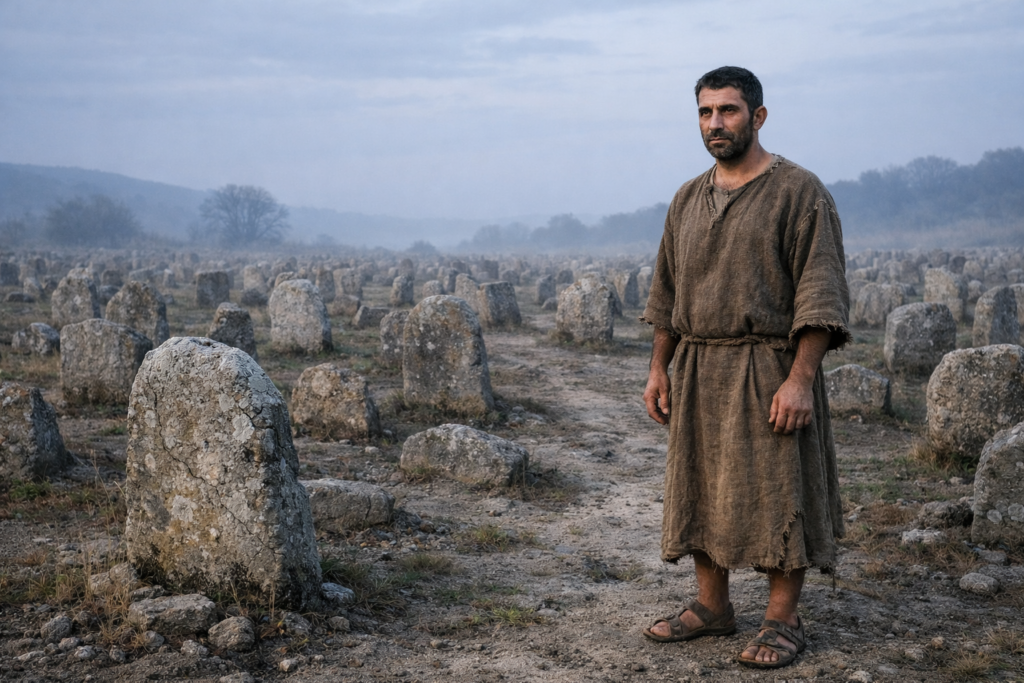
Picture this. You’re standing in a cemetery. Row after row of headstones stretching into the distance. Each one marks the end of a story. But what if I told you that in Genesis chapter 5, God turned a graveyard list into the most powerful testimony about truth versus lies the world had ever seen?
Because that’s exactly what happened.
The serpent in Genesis 3:4 looked Eve straight in the eye and said those famous words: “You will not surely die.” It was the first lie. The original deception. But God had already spoken in Genesis 2:17: “You are dust, and to dust you shall return.” So whose word would prove true?
Genesis 5 answers that question with brutal honesty. Eight times in this single chapter, you’ll read the same phrase repeated like a drumbeat: “and he died.” Adam lived 930 years and he died. Seth lived 912 years and he died. Enosh lived 905 years and he died. The refrain continues through Kenan, Mahalalel, Jared, and on down the line.
This isn’t just a genealogy. It’s God’s receipt. His proof of purchase. His way of saying: I told you the truth. The serpent lied. And here’s the evidence written in human history itself.
But here’s where it gets interesting. Because this chapter that seems obsessed with death is actually titled “the book of the generations of Adam” in Genesis 5:1. Is it a birth record or a death certificate? Both. And that’s the genius of it. Every birth carries within it the seed of death. Every beginning contains an ending. Adam was real. His genealogy is historical. And his curse became our inheritance.
Therefore when skeptics today claim Adam was merely symbolic, they’re not just disagreeing with Moses. They’re disagreeing with Paul in Romans 5:12-19. They’re disagreeing with Jesus himself in Matthew 19:4-6. You can’t build a real genealogy on a symbolic foundation. Either Adam lived and died, or the entire biblical narrative crumbles at its base.
The numbers in this chapter tell their own story. 930 years. 912 years. 905 years. 962 years. These aren’t random ages pulled from mythology. They’re God’s strategy for preserving oral tradition before writing became widespread. Think about it. Only five generations separated Adam from Moses. Adam knew Methuselah. Methuselah knew Shem. Shem knew Isaac. Isaac knew Levi, Moses’ grandfather. Five people could pass down 2,500 years of history face to face, voice to voice, without a single word written down.
But God wasn’t just preserving information. He was preserving hope.
The Man Who Refused to Die
Right in the middle of this death march, something breaks the pattern. Genesis 5:21-24 introduces us to Enoch. “Enoch walked with God three hundred years after he fathered Methuselah. Thus all the days of Enoch were three hundred sixty-five years. Enoch walked with God, and he was not, for God took him.”
No death announcement. No grave. No dust returning to dust. Just… gone. Taken. Translated. Hebrews 11:5 clarifies it: “By faith Enoch was taken up so that he should not see death, and he was not found, because God had taken him.”
Here’s what makes this staggering. The entire chapter is proving that God’s word about death was true. Every patriarch falls. Every generation ends. Death reigns from Adam to Moses, just as Paul would later write in Romans 5:14. Therefore when Enoch vanishes without dying, he’s not contradicting God’s word. He’s foreshadowing its ultimate fulfillment. He’s proving that the same God who spoke death into existence as judgment can speak life back into existence as grace.
But what did Enoch do to earn this? The text gives us one phrase repeated twice: “Enoch walked with God.” That’s it. No miracles listed. No great sermons recorded. No mighty works cataloged. Just walking. Walking implies movement. Direction. Companionship. Amos 3:3 asks the question: “Do two walk together unless they have agreed to meet?” Enoch and God agreed. They met. They walked. For 300 years.
Think about that. Enoch started walking with God at age 65. Something happened that year. Most scholars believe it was the birth of his son Methuselah, whose name means “when he dies, it shall be sent.” It was a prophecy embedded in a name. A warning whispered every time someone called the boy to dinner. Methuselah would become the oldest person in the Bible, living 969 years, and the year he died the floodwaters came exactly as his name predicted.
Therefore Enoch’s walk with God began when he understood two things simultaneously. Judgment was coming. But God was merciful enough to warn. The same God who would send catastrophe was the God worth walking with for three centuries.
Three Men, Three Victories
Hidden in Genesis 5 is a pattern that echoes through Hebrews 11. Three patriarchs are lifted up as heroes of faith: Abel, Enoch, and Noah. Not coincidentally, they represent three victories over three catastrophes that entered through Adam’s sin.
Abel conquered sin. Genesis 4:4 tells us “the Lord had regard for Abel and his offering.” Why? Hebrews 11:4 explains: “By faith Abel offered to God a more acceptable sacrifice than Cain, through which he was commended as righteous.” Abel understood what his parents learned in the garden when God covered their nakedness with animal skins in Genesis 3:21. Blood must be shed. Sin must be covered. Righteousness comes through faith in God’s provision, not human effort.
Enoch conquered death. In a chapter where “and he died” rings out like a funeral bell, Enoch silences it. He proved that walking with God leads somewhere beyond the grave. He became the first human to enter heaven without passing through death’s door. He was the preview of what Jesus would later promise in John 11:25-26: “I am the resurrection and the life. Whoever believes in me, though he dies, yet shall he live, and everyone who lives and believes in me shall never die.”
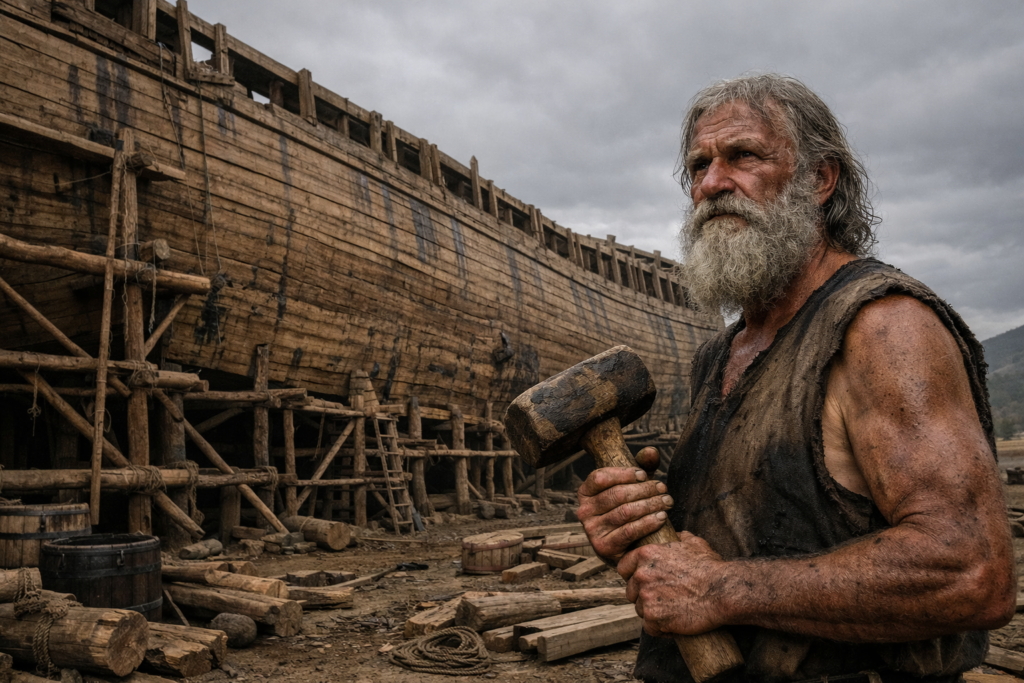
Noah conquered judgment. Genesis 6-9 will show us how, but his presence at the end of this genealogy is no accident. The flood that Methuselah’s name predicted, that Enoch’s prophecy in Jude 14-15 foresaw, came exactly as God said. Yet Noah found grace in the eyes of the Lord in Genesis 6:8. The ark he built became the only escape from universal judgment.
Sin. Death. Judgment. These are the three consequences of the Fall. But faith in God provides victory over all three. That’s the hidden message of Genesis 5. Death proves the serpent lied. But scattered through the death list are hints that God’s final word isn’t death at all. It’s life.
The Names Tell the Story
But there’s something even more remarkable hidden in this chapter. If you know Hebrew, the names themselves form a sentence. A gospel message encrypted in a genealogy written centuries before the gospel was preached.
Adam means “man.” Seth means “appointed” or “compensation.” Enosh means “mortal” or “frail.” Kenan means “sorrow.” Mahalalel means “the blessed God.” Jared means “shall come down.” Enoch means “teaching” or “dedicated.” Methuselah means “his death shall bring.” Lamech means “despairing.” Noah means “comfort” or “rest.”
Read them together: Man appointed mortal sorrow. The blessed God shall come down teaching. His death shall bring the despairing comfort.
That’s the gospel in Genesis 5. Written in names before the patriarchs who bore them were born. Man is appointed to mortal sorrow, but the blessed God shall come down teaching, and his death shall bring the despairing comfort and rest. It’s Jesus. From beginning to end, it’s always been Jesus.
Therefore this chapter that seems like the driest reading in all of Scripture turns out to be one of the most profound prophecies in the Bible. Every name points forward. Every death proves God right and the serpent wrong. Every long life gave more time for repentance. Even Methuselah’s record-breaking 969 years was God’s patience on display, delaying judgment as long as possible while one more generation heard the warning.
Your Walk Starts Here
So what does this mean for you today? Three things.
First, stop trying to start your walk with God anywhere except at the altar. Abel’s lesson still stands. You can’t approach God on your terms. You need blood. You need sacrifice. You need the Lamb of God who takes away the sin of the world, as John 1:29 declares. There’s no walking with God that doesn’t begin at the cross of Jesus Christ. His death brings the despairing comfort. His blood speaks a better word than the blood of Abel, according to Hebrews 12:24. Start there or don’t start at all.
Second, understand that walking with God is possible even when everyone around you is running away from him. Enoch lived in the same corrupt world described in Genesis 6:5, where “every intention of the thoughts of man’s heart was only evil continually.” But he walked with God for 300 years anyway. Your culture doesn’t determine your walk. Your choice does. Second Corinthians 6:17 still applies: “Therefore go out from their midst, and be separate from them, says the Lord.” Enoch proved it’s possible. Noah proved it’s sustainable. You can prove it too.
Third, remember that where you start determines where you end. If your beginning is at the cross, your ending will be in glory. If your beginning is anywhere else, your ending is Genesis 5 style: and he died. First Corinthians 15:22 makes it plain: “For as in Adam all die, so also in Christ shall all be made alive.” You’re either in Adam, headed to dust, or in Christ, headed to glory. There’s no third option.
The serpent’s lie in the garden was “you will not surely die.” Genesis 5 shouts back: yes you will. Eight times it shouts it. But between the shouts, Enoch whispers something different. He whispers that walking with God leads somewhere death can’t follow. He whispers that the grave isn’t the final word for those who know the God of the living.
The Final Word
Here’s what keeps me up at night. Enoch walked with God starting at age 65. That means for 65 years, he didn’t. For 65 years, he lived like everyone else in Genesis 5. He was born. He had children. He worked. He existed. But he didn’t walk with God until something changed him.
What changed him? Methuselah. The birth of a son whose name meant judgment was coming. Suddenly, life got urgent. Suddenly, walking alone didn’t make sense anymore. Suddenly, he needed to walk with someone who could save him from what was coming.
Therefore the question isn’t whether judgment is coming. Genesis 5 settled that. God’s word is true. The serpent lied. Death came just as God said. And death still comes. Hebrews 9:27 confirms it: “It is appointed for man to die once, and after that comes judgment.”
The question is: are you walking with God?
Because Enoch proved something that every grave in that chapter contradicts. He proved that walking with God for 300 years leads to not dying at all. He proved that intimacy with God transforms mortality into translation. He proved that the same God who spoke death into Adam’s future can speak life into yours.
But you can’t walk with someone you’ve never met. And you can’t meet God anywhere except where he’s chosen to meet you. For Enoch, it started at an altar where blood spoke of coming judgment. For you, it starts at a cross where blood speaks of judgment satisfied.
The genealogy of Adam ends in death. The genealogy of Jesus, which Matthew 1:1 calls “the book of the genealogy of Jesus Christ,” ends in resurrection. You’re in one list or the other. You’re walking toward dust or toward glory. You’re proving the serpent right or proving God right.
Enoch walked with God. Then he wasn’t, because God took him. That’s how every story should end. But it only ends that way if it begins at the altar, continues in obedience, and trusts that the God who spoke death into existence as judgment has the final authority to speak life back into existence as grace.
The chapter that proves everyone dies also proves one man didn’t. And if one could escape, so can you. Not by living long enough. Not by being good enough. But by walking with the God who already died in your place so you wouldn’t have to.
That’s the gospel hidden in Genesis 5. Man appointed mortal sorrow. But the blessed God came down teaching. His death brought the despairing comfort. And everyone who walks with him will discover what Enoch discovered: God’s final word isn’t death at all.

When Angels Fell and Giants Rose
The Door in the Side Changes Everything