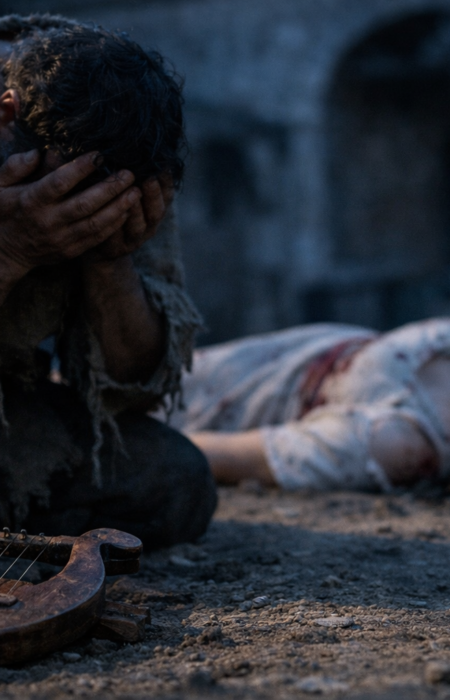
You think your family is complicated.
King David’s daughter Tamar wore a robe that marked her as untouchable. Virgin daughters of the king dressed this way, and everyone knew what it meant. The fabric declared her purity, her status, her future. Therefore, when she walked through the palace corridors, she moved with the confidence of someone protected by law, by custom, by her father’s throne.
But protection is only as strong as the people who enforce it.
When Trust Becomes a Trap
Tamar had a half-brother named Amnon. The text tells us he became obsessed with her, consumed by a desire so twisted it made him physically ill (2 Samuel 13:1-2). His friend Jonadab, described as “a very shrewd man,” saw through the performance and offered advice that would destroy multiple lives. Pretend to be sick. Ask your father to send Tamar to care for you. Create the opportunity.
David sent his daughter straight into danger.
She arrived believing she was on an errand of mercy. She prepared food with her own hands, the kind of tender care siblings should be able to offer each other without fear. Amnon watched her work. He sent everyone else away. Then he grabbed her.
Tamar begged him to stop. She appealed to his conscience, to their shared father, to the law, even offering alternative solutions if he truly wanted to marry her (2 Samuel 13:12-13). Therefore, we know she fought with words when physical resistance proved useless. She tried everything a desperate person tries when the unthinkable is happening.
But Amnon was stronger.
After violating her, something shifted in him. The text says his hatred for her became even greater than the lust that had consumed him (2 Samuel 13:15). He ordered her thrown out like garbage. Tamar, in her devastation, tore that special robe and put ashes on her head, ancient gestures of mourning and disgrace. The clothing that once announced her status now hung in strips, a perfect picture of what had been stolen from her.

The Silence That Screamed
Her full brother Absalom found her. He asked what happened, then immediately told her to be quiet about it. “Don’t take this thing to heart,” he said (2 Samuel 13:20). The words sound almost compassionate, except they’re not. Therefore, Tamar went to live in Absalom’s house, described by scripture as “desolate,” a woman whose life had been shattered while everyone moved on.
King David heard everything. The text tells us “he was very angry” (2 Samuel 13:21). But anger without action is just noise. David did nothing. He didn’t confront Amnon. He didn’t demand justice for his daughter. He didn’t even seem to speak to Tamar about what happened. His silence communicated more than any words could: her violation mattered less than keeping peace in his house.
Absalom said nothing to Amnon, neither good nor bad (2 Samuel 13:22). But silence can be a form of planning.
Two years passed. Amnon probably thought he’d gotten away with it. David had moved on. Life in the palace continued. Therefore, when Absalom invited all the king’s sons to a sheep-shearing celebration, it seemed like reconciliation. The festivity, the food, the wine flowing freely. This was how families healed, right?
Absalom waited until Amnon was drunk and vulnerable. Then he gave the order to his servants: “Strike Amnon down” (2 Samuel 13:28-29). The celebration became a crime scene. The other brothers fled in terror, initially believing Absalom had killed them all. But Absalom had only wanted one man dead.

The Question No One Wants to Answer
Here’s where the story gets uncomfortable for those of us who like tidy moral categories.
Absalom fled to exile. Tamar remained in his house, desolate. Amnon was dead, but was justice served? David mourned for his son, the rapist, but there’s no record of him mourning for his daughter’s stolen future. Therefore, we’re left with a story that refuses to resolve cleanly, that won’t let us walk away feeling satisfied with how things turned out.
Because they didn’t turn out. They fell apart.
The reality scripture presents here cuts deep: sometimes the people who should protect you won’t. Sometimes the authorities who could intervene choose silence. Sometimes justice comes in forms we can’t endorse even when we understand the rage behind it. And sometimes victims are forgotten in the aftermath of everyone else’s drama.
But here’s the truth that matters more than our discomfort: God doesn’t forget. When David failed his daughter, when the palace moved on from her pain, when scripture itself seems to leave her in that desolate house without resolution, the same God who noticed Hagar in the wilderness (Genesis 16:13) saw Tamar too. The God who declares “I know the plans I have for you” (Jeremiah 29:11) doesn’t limit that promise to people whose stories ended well in the biblical text.
Jesus Christ came for the Tamars of the world. He came for people whose families failed them, whose trauma was minimized, whose voices were silenced. When He said “the Spirit of the Lord is upon me, because he has anointed me to proclaim good news to the poor, to proclaim liberty to the captives, and to set at liberty those who are oppressed” (Luke 4:18), He was talking about every person whose dignity was stolen and whose pain was ignored.
The call here isn’t to find meaning in Tamar’s suffering. The call is to refuse to be like David. To refuse to be the person who hears about injustice and does nothing. To refuse to prioritize peace over protection, reputation over righteousness. Christ calls His followers to see the desolate, to name what happened to them as evil, to act with the courage that earthly fathers sometimes lack.
Your move toward Jesus starts with honest acknowledgment: the world breaks people, sometimes through the hands of family, often while authorities watch. Therefore, faith isn’t about pretending everything works out in this life. Faith is trusting that God sees, that Christ came specifically for the broken, and that the kingdom He’s building will finally deliver the justice that David’s palace never did.
The robe Tamar wore was supposed to protect her. But you think any symbol can make you truly safe when the people around you refuse to act.


A Mother’s Vigil That Changed a King’s Heart
Wrestling God for Your Breakthrough